For many veterans, a service dog is more than a companion. It’s a vital tool for navigating daily life with a disability. However, as Army veteran William McCasland recently discovered, public understanding of the Americans with Disabilities Act (ADA) still lags behind the law.
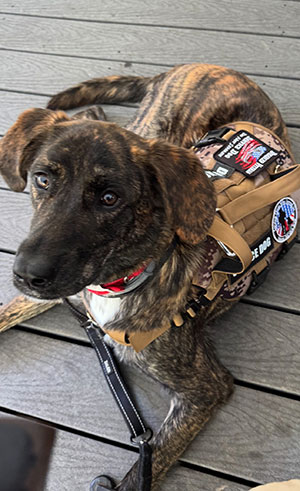
While traveling for a family reunion, McCasland, who is a member of DAV Chapter 11 in Waterbury, Connecticut, and his service dog, Kobe, were initially welcomed at several hotels and restaurants. That changed at a hotel in Mississippi when staff informed him that “pets” aren’t allowed in the dining area.
“I said, ‘Well, you have to understand this is not a pet. This is a service dog,’” McCasland said. Despite his explanations and Kobe’s well-trained behavior, McCasland was asked to leave the area, an experience he described as deeply embarrassing.
The confrontation highlights a common hurdle: Businesses often conflate highly trained service animals with emotional support animals or pets, despite clear legal distinctions.
The incident in Mississippi was particularly jarring for McCasland because it followed a week of seamless travel. The confusion began when a hotel staff member noticed McCasland practicing a controlled entrance—a training routine where Kobe sits and waits for a treat before entering a building. When asked if the dog was training, McCasland, a firm believer that a service animal’s proficiency requires constant reinforcement, replied that Kobe is “always training.” This simple statement was later used by the hotel to justify his ejection from the dining room, with management claiming the dog was merely a service dog in training and therefore not protected by the ADA.
Angelica Williams, an Air Force veteran and community outreach coordinator for the Department of Justice (DOJ) Civil Rights Division, emphasized that the ADA is designed to protect access for individuals with disabilities. According to Williams, there are four basic things you need to know:
- The definition of a service animal: Under the ADA, a service animal is a dog individually trained to perform specific tasks that directly relate to a person’s disability.
- Tasks versus support: Tasks can include alerting a person with post-traumatic stress disorder to an oncoming panic attack or providing deep pressure therapy. Critically, providing only comfort or emotional support doesn’t qualify a dog as a service animal under the law.
- The two-question rule: When it isn’t obvious what service a dog provides, staff at a business may only ask two questions:
- Is the dog a service animal required because of a disability?
- What work or task has the dog been trained to perform?
- Prohibited inquiries: Staff can’t ask about the nature of the disability, require a demonstration of the task, or demand documentation like certification or a doctor’s note.
Williams highlighted that the ADA’s protections are contingent on the handler maintaining effective control of the animal. This goes beyond obedience and includes specific legal standards for how a service dog is handled in public.
Under DOJ regulations, a service animal must generally be harnessed, leashed or tethered. However, if a handler’s disability prevents the use of a leash or if a tether interferes with the dog’s safe and effective performance of its work, the handler isn’t required to use one. In these cases, the handler must still maintain control through voice commands, hand signals or other effective means.
A handler can be legally asked to remove their service dog from the premises if it’s out of control—behaviors like growling, biting or excessive barking—and if the handler doesn’t take effective action to correct it.
Williams acknowledged that legitimate service dog teams often face unfair scrutiny due to the presence of poorly behaved pets or fake service animals in public spaces. To handle these high-tension moments, she suggests that veterans should calmly restate the two-question rule and explain the specific task the dog is trained to perform to distinguish them from a pet. If a business owner remains confused about the law, veterans can refer them to the DOJ’s published fact sheet available at servicemembers.gov. If a veteran is still denied access despite the dog being under control and performing a task, they may file a formal ADA complaint through the portal at ada.gov.
A major point of confusion for both veterans and businesses is the rise of online registration services. Williams warns that these services are unnecessary and can be intentionally misleading, noting that veterans are often inundated with ads for licensing and registration. According to Williams, because of their military background, veterans may feel more pressure than civilians to have proper documentation.
This confusion is further fueled by recent changes in air travel. While the U.S. Department of Transportation updated its rules in 2021 to allow airlines to exclude emotional support animals and require specific forms, those rules don’t apply to hotels, restaurants or shops. Business owners may learn about these airline requirements and mistakenly overcorrect, demanding the same documentation in spaces where the ADA guarantees access without it.
It’s critical for veterans to understand that private companies offering these certifications often prey on their desire to follow the rules, according to Williams. These documents have no legal weight under the ADA.
“The ADA explicitly states that service animals are not required to be certified or go through a professional training program,” Williams said. This means a dog that a veteran personally trains, provided it’s under control and trained for a specific task, meets the same service dog requirements as one trained by an accredited organization.
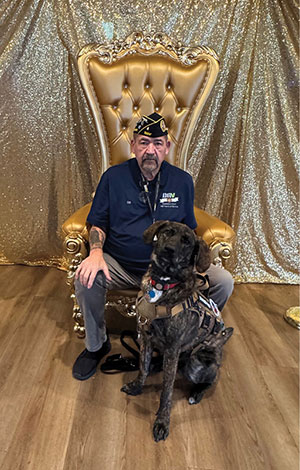
For McCasland, the goal of sharing his story is education. By pursuing a formal complaint and seeking compliance training for the hotel staff, he hopes to ensure the next veteran who walks through the hotel’s doors is met with understanding rather than confrontation.
“I want to make it about all our veterans that have service dogs that are out there in the community,” McCasland said.
While veterans like McCasland fight for their right to public access under the ADA, many others struggle just to obtain a service dog. To bridge this gap, DAV is advocating for the Service Dogs Assisting Veterans (SAVES) Act (H.R. 2605/S. 1441). This legislation would create a pilot program at the Department of Veterans Affairs to fund the training and placement of service dogs for veterans with conditions like traumatic brain injury and military sexual trauma. The veterans would pay nothing and would also receive veterinary insurance to ensure these lifesaving animals can get the care they need. n
Learn more online
For more information about the ADA, visit ada.gov.
For information on service members and veterans initiatives, visit servicemembers.gov.