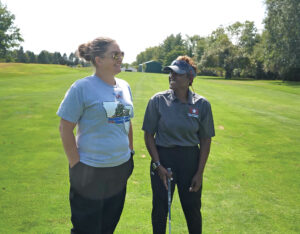
Tracey Miller exhaled slowly as she stepped up to the golf ball lying in the fairway and focused her mind on this next shot, just as she had been taught. Then, she drew her club back and swung with all her might.
She missed the golf ball completely; the momentum of her follow-through spun her around.
“There’s the ‘Texas Tornado,’” Amy Letcher said, laughing.
Miller smiled and pointed at Letcher, acknowledging she’d heard the nickname, before she lined herself up again, refocused and hit a solid approach toward the green.
Letcher’s friendly teasing only lasted a moment. She quickly shifted to giving Miller feedback and coaching for the next shot.
“The first year, I could not hit at all,” Miller said. “But she doesn’t judge me, and she’s always patient with me. She knows about my disabilities.”
This was the third year they both came to the National Disabled Veterans Golf Clinic in Riverside, Iowa, and were partnered together all three years. Miller, an Army veteran of 30 years, is a participant. Letcher is her golf buddy—helping her navigate the course, the game of golf and sometimes even life.
Hitting a wall
After Miller retired from the Army in 2018, she said she hit a wall, struggling to fit in as she dealt with numerous medical issues.
“I thought I was really OK, but I wasn’t,” she said.
On deployment to Afghanistan in 2012, while she was at Forward Operating Base Mehtar Lam, Miller was injured by two enemy mortar rounds that struck near her. Her injuries included brain bleeding and a traumatic brain injury (TBI).
She spent the next two years in rehabilitation going through physical, speech and occupational therapy so she could stay on active duty, but the experience drained her self-confidence.
“I didn’t really know if I was going to be a capable senior leader,” Miller said. “But my care team did everything they could do to prepare me so I could finish my military career, and they did a great job.”
When she retired, Miller said she was still dealing with the effects of her TBI. Her balance was off; she was struggling with cognitive function; and she was experiencing post-traumatic stress disorder, anxiety and depression.
“I did hit the wall,” she said. “I didn’t enjoy anything.”
Determined to change course, Miller sought help through the Department of Veterans Affairs Whole Health program at her local medical center in Temple, Texas.
There, she was introduced to adaptive sports, including equine-assisted therapy, rowing and golf. Her recreation therapist recommended she apply for the golf clinic, which is co-presented by DAV and the VA annually.
She was accepted to the program but anxious about going at first, “because when you have a brain injury and other [invisible] injuries, it’s like nobody understands,” Miller said. “But coming to this golf clinic and participating shows me that someone does understand when you have an invisible wound.”
She described the feeling of attending the first time as being embraced by a warm blanket and gave much of the credit for that to her golf buddy, Letcher.
“She’s always looking out for me,” Miller said. “She makes me feel secure and gives me confidence when I’m out there.”
“That’s what we do,” Letcher said. “That’s what I’m here for—to make her feel comfortable and help her have a good time and enjoy the experience.”
Golf buddies: The vital piece
Miller, a DAV member of Chapter 29 in Harker Heights, Texas, was one of more than 200 veterans who participated in this year’s clinic. Each participant has a qualifying disability to attend, such as low vision or blindness, TBI, spinal cord injury, or amputation.
Clinic staff—many of whom are VA prosthetists or recreation and occupational therapists—outfit participants with specific, customized adaptions to help them play and enjoy the experience. No two accommodations are the same and can range from high-visibility golf balls and auditory cues for aiming to prosthesis-compatible golf clubs and specialty carts to accommodate limited mobility.

The one thing all veterans have in common on the course is a golf buddy who’s with them the entire time.
While the clinic provides PGA and LPGA instructors; staff experts, like recreation therapists to train and fit participants with customized adaptive equipment; and medical teams to ensure everyone’s safety, it’s these golf buddies who make the game truly accessible.
“Golf buddies are as vital a piece as any for a veteran making it through this clinic and making it a rehabilitative experience,” said Nick Beelner, the clinic’s director. “That’s the person who’s right there with the veteran on the same golf cart to get them through the hole.”
They’re the ones driving carts, teeing up balls, helping participants navigate the course and helping aim their shots.
“Without my golf buddy, I would be lost,” said Rowena Darwin, an Army veteran who has low vision and experiences vertigo from a TBI. “I wouldn’t be able to do this without her or anybody.”
Judy Sogoian is Darwin’s golf buddy. It was her first time volunteering at the clinic, and it was done to honor her father, a Coast Guard veteran who participated in the D-Day landing at Normandy during World War II. He died in 2024.
“He made such a difference in my life,” Sogoian said. “And being here with other vets, it just brings it closer to home. This is such a great group; it’s like family.”
Sogoian isn’t a golfer, but Darwin said her help locating the ball and guiding her around the course and the conversations in the golf cart have lifted her spirits as she continues to face several medical diagnoses.
“It gives me that sense of, I still have that freedom of being partially independent and being able to feel free versus staying at home and being sorry for myself,” Darwin said. “I think it’s an amazing thing that she’s doing for me.”
Bonds and friendships like these are formed each year on the course, “and that’s such an important part for the veteran,” Beelner said.

Navy veteran Anita Shorb has been paired with her golf buddy, Heidi Brown, for many years. The two have become close friends and keep in touch throughout the year.
“She’s my golf wife,” Shorb joked within earshot of her spouse, Glen Landenberger, who’s another clinic participant.
Shorb said that Brown and her husband’s golf buddy, David McAdon, have given the couple a chance to bond in a way they otherwise wouldn’t have. Shorb is blind and Landenberger has Parkinson’s disease, which limits his motor function.
“A lot of times we just can’t do the same things,” she said. “So it’s wonderful that we can do this. It’s important for us and important for our marriage.”
John Kleindienst, DAV’s national voluntary services director, helps plan the golf clinic each year. He said he hears every year from participants how important golf buddies are to the veterans’ overall experience of the clinic.
“They tell me how much these volunteers make them feel valued and seen,” he said.
“For some veterans, those aren’t words they use often. But year after year, I hear how much that interaction has been a turning point in a veteran’s life and really been something that has altered the direction of their life going forward.”
More than a game
That’s the case for Miller. For her, golf has helped with more than just her cognition, focus and anxiety.
“It really made me feel good,” she said. “It let me know that my life wasn’t over, and I wasn’t just going to retire and be a wounded veteran. Since coming to the golf clinic, I’ve become an extrovert again. I actually want to leave the house.”
Seeing progress like this and playing a role in Miller’s healing journey, Letcher said, is personally rewarding.
“It’s a very humbling experience to come out here every year and work with Tracey and all the other veterans,” she said, as she started walking toward Miller. She had a few things she wanted to go over with her grip and swing routine.
As they worked, Miller smiled.
“Maybe I won’t be called the Texas Tornado forever.”
Learn More Online
Miller received the clinic’s DAV Freedom Award, given to the participant who best exhibits the spirit of the clinic. To see her story, visit veteransgolfclinic.org.