 From the opening session to the commander’s closing remarks, a theme of community and connection ran through the 2025 DAV and Auxiliary National Convention in Las Vegas—reminding members that unity must be continually renewed, not assumed.
DAV leaders spoke about the organization’s accomplishments over the past year while stressing the importance of members being present in their communities and halls of government. They stressed that while technology is useful and vital for outreach, it can’t replace the value of face-to-face opportunities and interactions.
Nearly 3,000 DAV and Auxiliary members and their guests attended the convention. They elected new leadership, recognized volunteers and supporters, passed resolutions to establish the organization’s legislative agenda, and attended seminars and workshops on the many ways DAV serves ill and injured veterans and their families.
Purpose-driven leadership
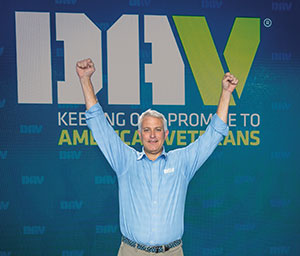
Delegates unanimously elected Coleman Nee as national commander, succeeding Daniel Contreras. Nee, a native of Boston, is a service-disabled veteran of the Marine Corps Reserve, serving from 1986 to 1994.
“I am humbled, I am honored, and I am infused with the spirit that you bring to this organization,” Nee said.
Nee is the son of a World War II veteran, and his own military service included a deployment to Saudi Arabia during the Persian Gulf War as a motor transport operator. From 2011 to 2015, he served as secretary of the Massachusetts Department of Veterans’ Services, helping create initiatives to increase veterans’ access to benefits and support those returning from war. He also served on DAV’s National Executive Committee and board of directors from 2017 to 2019.
He is a member of Chapter 3 in Dorchester, Massachusetts, and an adviser on DAV’s national board of directors.
Nee praised the training, organizational infrastructure and trusted status of DAV but said they can’t replace an intentional and present membership that’s visible in the community and before lawmakers.
“The greatest strength of this organization is in you, our members,” he said. “Let’s open our doors wider than before. Let’s raise our visibility higher than it’s ever been. Let’s tell our stories with boldness and pride—we should. Not just inside our halls, but outside our walls as well.”
On the march toward 1 million members, Nee said the most successful recruiting tool is creating volunteer opportunities and inviting veterans to continue to serve.
“We’re not going to grow by waiting; we’re only going to grow by doing. New members aren’t hanging around our chapter meeting rooms waiting for us to ask them to join,” he said. “Let’s make DAV unmissable in our communities.”
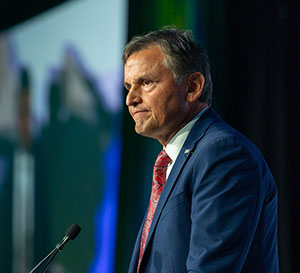
Outgoing National Commander Contreras, reflecting on his past year meeting and working with members, staff and lawmakers, said he’s seen great progress.
“It’s never been clearer to me that we are in a position to serve more veterans, more families, more caregivers and more survivors than ever before,” Contreras said.
The DAV Auxiliary elected Melissa Pierce as its new national commander, replacing Christopher Easley.
The full list of 2025–2026 national officers is available on Pages 28–29.
When Department of Veterans Affairs Secretary Doug Collins spoke to convention attendees, he praised DAV’s leadership and efforts and echoed the organization’s message of grassroots advocacy and bringing other veterans into the fold.
“I need you to go back into your communities, and I need you to help me,” he said. “I need you to find other veterans who may have been left aside—other veterans who don’t have the community and family that you have here at this convention.”
He also spoke of his commitment to simplifying the VA claims process and having a veterans-first approach behind every decision he makes.
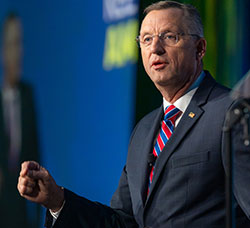
“I want a rebirth in how we look at the veteran population in our country,” Collins said. “I’m tired of the veteran population in our country feeling like they have to go and beg or borrow [to] get what they’ve already earned.”
During his report, National Adjutant Barry Jesinoski said it’s DAV’s charge to ensure those promises are kept.
“The fact is that we as a nation have asked a great deal of our veterans,” Jesinoski said. “We’ve sent them into combat and demanded they be capable of inflicting incredible lethality in unimaginable situations. We are called to appeal to the nation’s conscience and make our brothers and sisters who are changed in service whole.”
DAV’s benefits advocates, programs and partnerships help ensure veterans receive the support they need, he said, but it’s incumbent on members using the network of departments and chapters “to provide services and fill gaps so our brothers and sisters do not fall through the cracks.”
Insightful seminars
Much of the convention focused on seminars informing and equipping attendees with valuable tools and information to take back to their chapters.
One of the best-attended seminars was presented by the service and legislative staff. It featured an ask-me-anything format where a panel of DAV leaders answered members’ submitted questions. Topics ranged from handling discharge upgrades to the illegal activities of so-called claim sharks who charge fees to provide VA benefits claims assistance for veterans.
DAV Deputy National Legislative Director Jon Retzer condemned claim sharks’ actions and spoke against the proposed CHOICE for Veterans Act, which would weaken accreditation requirements for VA claims assistance providers and permit fees up to $12,500 for work that veterans service organizations and other accredited agents offer for free.
“That bill is giving the authority to these predatory agents [and] companies to take advantage of our vulnerable veterans and veterans who have worked hard for what they have earned,” Retzer said. “The CHOICE for Veterans Act does not protect us. It does not protect our fellow veterans or their family members.”
Another popular seminar featured a panel discussion about the research into the efficacy of psychedelics as a treatment option for veterans experiencing symptoms of post-traumatic stress and traumatic brain injury.
The conversation featured former NFL player Robert Gallery; former CNN correspondent AnneClaire Stapleton; Dr. Thomas Thompson, vice president of global clinical development for Otsuka, the seminar’s sponsor; and Justin Carlisle, a Marine veteran.
Gallery, Stapleton and Carlisle have all used psychedelics as part of their treatment and have found them to be life-changing and lifesaving.
“I was seriously dead before I had my psychedelic experience, and that experience woke me up,” Carlisle said. “It awoke me to the possibility of life again.”
Each of them is a vocal advocate for more research into using psychedelics as an effective treatment option. DAV also supports further research.
Thompson said that 10%–30% of people who are treated for depression don’t respond or underrespond to traditional treatment methods.
“This has the potential of a new way—a new frontier—in how we might be able to treat it,” he said.
Recognized service to veterans
The convention was also a time to recognize contributions and accomplishments of DAV members, volunteers and supporters.
Individual recognitions included Medal of Honor recipient Ken David, the longtime adjutant of DAV Chapter 11 in Warren, Ohio. David was recognized as the 2025 Disabled American Veteran of the Year for his dedication to helping other veterans and for the work he does at his local chapter, where he’s a constant presence. In his remarks, he told attendees that he remains committed to doing whatever is needed for other veterans.
“Never, never say no to a fellow veteran, and never, never give up on them,” David said. “Our nation owes a debt of gratitude to anyone who’s served. It’s DAV that follows through on that sacred responsibility and pushes our leaders to do the same.”
Nihar Kummetha, an incoming freshman biomedical student at the University of Pennsylvania, received a $30,000 DAV Scholarship for his more than 375 hours of volunteer work at his local VA medical facility in Charlotte, North Carolina. He first started volunteering at the VA the summer after his freshman year of high school and has returned every summer since, educating veterans on technology use, providing comfort items to veterans experiencing homelessness and creating a veterans wellness project.
“Listening to veterans’ stories helped me become more empathetic, resilient and truly a better person,” Kummetha said. “I plan to continue volunteering and giving back to veterans at the Philadelphia VA near my university and carrying forward the lessons of empathy, leadership and service that have shaped my journey.”
Former Cincinnati television news reporter Craig McKee was named the 2025 DAV Bugle Award recipient for his yearslong series “Homefront,” highlighting veterans’ issues in the Greater Cincinnati area. An Air Force veteran and DAV member himself, McKee used his platform to advance the interests of veterans and frequently showcased DAV’s volunteer work and programs, including the Transportation Network.
He said it was a sense of duty carried over from his time in uniform to use whatever platform he had to shine a light on those stories.
“When I first heard about receiving this award, I was humbled—frankly, I was a little overwhelmed,” McKee said, “because truthfully, telling veterans’ stories has never, ever been about recognition; it’s been about responsibility.”
Another convention highlight was the pitch competition presented by T-Mobile. In its second year, the competition featured six DAV Patriot Boot Camp alumni who showcased their businesses before a live audience to compete for $10,000 in non-dilutive funding.
The winner was Army veteran Yusuf Henriques, founder of IndyGeneUS Bio, which collects genetic samples from women and underrepresented populations to build a data bank that helps medical researchers develop more inclusive, effective treatments and drugs. He said the prize money will be used to help build out his company’s website to grow the number of people who send in their samples.
“I’m fortunate that I came out with the win, but any of the contestants could’ve walked away with the win,” Henriques said. “All are doing phenomenal things in different sectors.”
Another veteran celebrating a win at the convention was Luis Cortes, an Army veteran; member of Chapter 114 in Helotes, Texas; and the senior vice commander of the Department of Texas. Cortes won the first-ever DAV Recruiter Rally. The contest was open to any DAV or Auxiliary member who recruited at least one DAV member in the past year. Cortes’ name was randomly drawn from a pool of other eligible recruiters, winning an all-expense paid trip to the convention and $2,500 in spending money.
Winning the contest was a nice surprise, but Cortes said attending the convention allowed him to hear important information to take back to veterans in his area.
“For me, it’s very personal, because at one point in my life, it was very hard to get my benefits,” Cortes said. “That was a call for me to learn and educate myself about benefits and the law in order to help others not go through the same things that I’ve gone through.”
“Our convention is such an important event each year,” Jesinoski said. “Yes, we accomplish critical work that will carry us throughout the next year, but it’s also a great opportunity to recommit to each other our dedication to serving our fellow veterans and reminding them they have a home and a family at DAV.”
The Recruiter Rally will return for the 104th national convention, scheduled for Aug. 1–4, 2026, in Orlando, Florida. Visit dav.org/membership-recruiter-rally to learn how you could win a free trip for two to attend.
View awards and additional 2025 convention information here.
Related News & Events
Recreation therapy helps veterans rebuild life after injury
Thousands helped, more welcome

The modern covenant

A morning walk, a Purple Heart, a debt paid