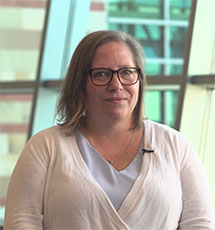
 Christine Knight was at the chow hall at Camp Caldwell in Iraq when she heard of American contractors killed on a bridge in the western part of the country. Her unit was preparing to head back home when a vague request came in for medical support for an upcoming operation.
Knight was randomly selected for the mission. Five teams loaded their tracked ambulances and began convoying from northeastern Iraq to Fallujah.
Her service in the Wisconsin and North Carolina Army National Guard was largely filled with training and practicing everything from running a field hospital to conducting mass casualty drills.
“Thank God we had that monotonous, over-and-over training, because when I had to put those tasks in play, I was on autopilot,” Knight said.
As a medic, Knight stayed in the back of an ambulance, ready to provide lifesaving care following the initial bombardment. “Sitting and not doing anything is the worst,” she said.
When her unit first began receiving injured Marines, Knight helped treat shrapnel and gunshot wounds to the arms or legs. Once the force reached the Fallujah government center, countless casualties began pouring out.
The carnage she saw was unlike anything she’d experienced before. Knight’s vehicle transported Jacob Knospler, a wounded Marine with a missing jaw, to the aid station. On the seemingly endless ride to the relative safety of a field hospital, she and others worked to keep Knospler’s airway open. “That was the most critical case I saw in the city, and he is alive today, which is amazing,” she said.
As Knight recalls, the days blurred into weeks, and she became unable to remember any specific day.
Knight convoyed back to Camp Caldwell toward the end of November, where she was met with a parade and accolades by her fellow soldiers. However, any celebrations were short-lived, particularly around the holiday.
“There are people who will never have Thanksgiving again,” she said. “I can’t sit here and be here with these people and be happy to be back when so much fighting has been going on.”
The Battle of Fallujah was at the end of Knight’s deployment. She wanted to be left alone to find some quiet. She became angry and tearful. “I was not myself at all,” she said. “I was pretty miserable to be around.”
After she returned home, she felt “like a zombie” and was merely existing rather than living. Knight didn’t confront her combat experiences until a decade later.
Despite her challenges in returning to normal civilian life, Knight remains confident and proud of her service in Fallujah. “I was meant to be there,” she said. “I’m stronger than I think.”
In the years since leaving the military, she has held on to the sense of purpose she found as a medical professional by working as a registered nurse. Most days, she thinks of Fallujah.
“It’s something I’m very proud of,” she said. “That’s why we’re medics, to get people back to who they are supposed to be.”
Learn more about Fallujah: 20 Years Later at fallujahstories.org.
Related News & Events

Life membership rate rises to $350 in 2027
Veteran suicide prevention: Why connection matters