
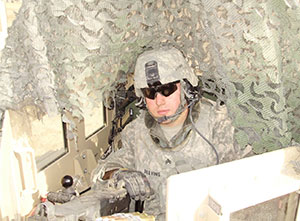
A 60-mile bike ride through the southern Arizona mountains was enough for Daniel Blevins to calm down and collect his thoughts. But once he began recording cellphone video to put those thoughts out into the world, the exhaustion from such an arduous journey kept him from making the kind of impactful and coherent statement he was hoping for.
The following day, Blevins laid out his thoughts on social media in response to what had gotten him so riled up—an article written by The Washington Post alleging that disabled veterans are “swamping” the Department of Veterans Affairs with false, fraudulent and dubious disability claims for minor or illegitimate injuries and illnesses.
As a former VA employee, DAV life member, and national board-certified health and wellness coach, the disabled Army veteran knew better.
“I was livid. I was pretty much seeing red,” Blevins said before explaining that he has lost a “staggering amount” of friends to veteran suicide in the 14 years since taking off his uniform. “I’ve had friends who showed up to the VA who didn’t get the care they needed, and they went home and killed themselves that same day. And that article is going to keep that person from even going in the first place.
“People read that, word gets out, they see it all over social media, and it’s going to have this ripple effect of dead veterans.”
“In our view, this story was neither investigative news reporting nor analysis,” DAV National Legislative Director Jon Retzer testified at an October 2025 Senate Veterans’ Affairs Committee hearing that explored the VA disability system and was spawned by the article. “It was a long-form editorial developed from a preconceived conclusion that they then tried to support with a series of misleading and conflated statistics; anecdotal quotes transformed into generalizations; unsupported assertions; and a near-total misunderstanding about the history, purpose and functioning of the VA disability compensation system.”
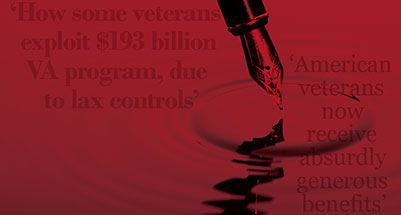
The article, “How some veterans exploit $193 billion VA program, due to lax controls,” points to the large number of veterans awarded disability compensation in recent years and highlights a small number of outrageous frauds committed by a relative handful of individuals.
According to the VA Office of Inspector General, there have been fewer than 200 fraud convictions annually in recent years. With the Veterans Benefits Administration processing almost 3 million claims in the most recent fiscal year, that equates to a fraud rate of less than one one-hundredth of 1%.
One of the article’s main themes that Blevins took umbrage with is minimizing the effects of what it called “minor or treatable afflictions” such as hemorrhoids, eczema and acne—all of which affect his daily life.
“One of my disability claims is listed as hemorrhoids. Sounds minor, right? Something to mock in an article?” Blevins wrote in his social media post. “The truth: It’s unexplained rectal bleeding I’ve dealt with since Iraq. I bleed multiple times a week. It wrecks my schedule, ramps up my anxiety, and forces me to plan entire days around managing it.
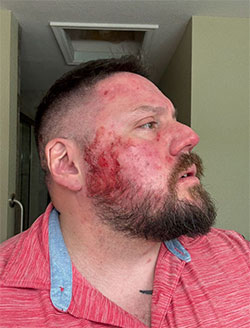
“They also slam veterans for claiming ‘pimples and acne,’” he continued. “Since Afghanistan, I’ve had sores erupt across my back and face that bleed, scar, and burn like fire.”
Beyond those afflictions, the article also highlighted the fact that many veterans file claims for multiple disabilities. The undeniable truth, though, is that the rigors of military service can take a toll on one’s body.
In Blevins’ case, a 2008 Humvee rollover caused a spinal injury that resulted in the left side of the former cavalry scout’s body becoming atrophied and has contributed to his sciatic nerve radiculopathy and carpal tunnel syndrome. His positioning between bomb-jamming devices and proximity to mounted .50-caliber machine guns on Humvees also left him battling intense migraines—another one of the “common disabilities” the article takes aim at, along with erectile dysfunction, which Blevins also suffers from.
He knows all too well about the stigma associated with submitting VA disability claims. His more than a decade of work in the veteran community has allowed him to witness the common refrain many DAV members and service officers hear: Many veterans feel they don’t deserve VA health care and benefits because they perceive their disabilities as minor and believe other veterans are more deserving.
“They’re going to think, ‘This is just a small issue of rectal bleeding. This is just a small cyst on my back,’” he said. “The reality is, your quality of life is going to suffer all the way until you die young from it.”
Blevins admits he’s concerned about that possibility when it comes to his issues, which is why seeing them minimized in the media and in the eyes of other advocates looking to dismantle the VA disability system is so upsetting. He also worries about how the outcomes of his “minor afflictions” will affect his wife and three children.
“There is such a reduced quality of life by joining the military,” he said. “If you were to show me how my disabilities were going to keep getting worse over time and the access to care wasn’t going to get too much better, I would have never started a family in a million years.”

The Washington Post’s coverage isn’t the only instance of attacks on veterans benefits recently. In November 2024, The Economist published “American veterans now receive absurdly generous benefits,” which characterized veterans disability payments as roadblocks to national-debt reduction efforts. That article also received tremendous rebuke in the military and veteran community. Together, these and other media reports that take aim at veterans health care and benefits represent a larger danger.
“To create this narrative that people don’t deserve the health care that they desperately need and earned could only be brought by somebody that is so out of touch with reality,” Blevins said. “[Politicians] are going to read that, and they are going to make funding decisions based on that. And it is going to affect VA programs across the board.”
“Veterans aren’t defrauding the government,” Blevins wrote in his social media post. “We’re navigating a system that forces us to prove our bodies are broken in the right way to get basic health care.
“This kind of reporting doesn’t just mislead the public—it fuels stigma, discourages people from seeking help and hands ammunition to lawmakers who already think cutting veteran support is a budget fix.”
Still, Blevins maintains that his story is similar to countless others.
“I got out [of the military] completely uninformed and broken,” he said. “And then it was 100% on the VA to try to make me better.”
Related News & Events
Creating a united force through member recruitment

Here’s what came from historic women veterans legislation
DAV programs are empowering businesses that hire veterans