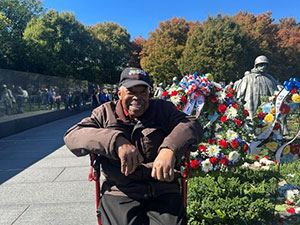
William Bolden was caught in a firefight with Chinese soldiers when the ice beneath his boots began to crack. Carrying two canisters of .30-caliber ammunition, the Army infantryman suddenly found himself waist-deep in freezing water. The pendulum of combat swung between the biting Korean winter and a relentless enemy.
“The Chinese wouldn’t let me stop and change,” he said. “So my clothes actually freeze-dried on me.”
He remained in the creek until the fighting subsided. Afterward, Bolden visited the unit medic about a persistent blister. “He said, ‘Don’t you know your foot is frozen, man?’” Bolden recalled.
Six flights later, he was recovering at Percy Jones Army Hospital—a recovery center for service members with cold-weather injuries—in aptly named Battle Creek, Michigan.
Every passenger on that flight out of Korea had suffered severe tissue damage after enduring the dead of winter. In addition to frostbite on his upper and lower extremities, Bolden sustained shrapnel injuries to his left arm and shoulder.
For decades, Bolden—now 100 years old—didn’t receive the veterans benefits he had earned. That changed last year when he reached out to DAV, looking only for an ID card so his wife, Joanna, could shop at a military base commissary. The veteran went in for credentials but came out with a lifeline.
In addition to fighting in the Korean War, Bolden had served in World War II with an all-Black unit that provided critical support to combat troops. As was standard practice in the segregated U.S. military, most Black soldiers were assigned to noncombat and support roles, including transportation and supply.

His unit followed the 1st Cavalry Division to the Philippines to help liberate Manila, the nation’s capital, from Japanese occupation. Bolden was preparing for the invasion of Japan when news arrived that the war had ended. After a four-year break in service, he reenlisted in the Army on June 8, 1950—just 17 days before the Korean War broke out. This time, he served in a desegregated combat unit.
“We found out a soldier is just a soldier,” said Bolden. “There was no difference.”
The trauma he endured on the frozen Korean Peninsula stayed with him. According to Joanna, he sometimes wakes suddenly at night, urging her to get into a foxhole. Today, his mobility is limited, and he often relies on a walker to get around.
Bolden filed for veterans benefits for his cold-weather injuries and post-traumatic stress disorder on his own in 2013. The Department of Veterans Affairs denied his claim. Dejected, he and Joanna stopped trying to secure the benefits he’d earned decades earlier.
But after meeting DAV National Service Officer Danny Soto, things began to change.
Once Soto accessed Bolden’s military records, he discovered a glaring mistake. “The VA turned him down for PTSD and frostbite,” said Soto, “even though both were noted in his discharge record from Korea. So we refiled everything.”
Soto stayed in constant contact with VA officials and other offices in DAV’s network to expedite Bolden’s veteran’s claim. In September, Bolden received the news that his claims for frostbite injuries had been approved—transforming life for him and Joanna. Claims for his shrapnel wounds and PTSD remain pending, but Soto is confident DAV will get them across the finish line.

In addition to uncovering the earlier mistake, Soto said Bolden received a subpar compensation and pension exam in 2013. “He didn’t even know he could appeal,” added Soto.
When the approval news arrived, Bolden was in disbelief. “I was astonished,” he said.
“I’m grateful,” added Joanna. “I think he should have received it years ago. After everything he’s been through, he should have had his benefits long before now.”
Related News & Events


Orlando to host 2026 DAV and Auxiliary National Convention