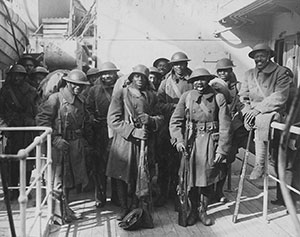
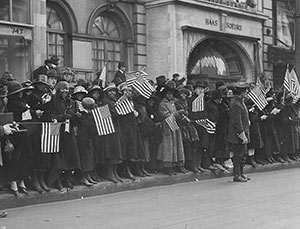
 Even the blaring sounds of a 100-piece jazz band turned to whispers in the throngs of cheering Americans who lined New York City’s Fifth Avenue on Feb. 17, 1919.
It was the city’s first homecoming for troops returning from the Great War. The Sun newspaper described the crowds as “two solid walls of booming, roaring welcomers,” and soldiers “decorated with flowers like brides.”
The men were the city’s own, having originated as the 15th New York National Guard Regiment in Harlem before being shipped off to France as the 369th Infantry Regiment. They quickly gained a reputation for their steadfast fierceness in battle, eventually earning the moniker “the Harlem Hellfighters.”
“Theirs is the finest of records,” the New York Tribune reported at the time. “Under fire 191 days, they never lost a prisoner or a foot of ground.”
But their welcome was a far cry from the regiment’s sendoff in 1917 when they were prohibited from marching in the farewell parade of New York’s National Guard because of the color of their skin.
It wasn’t the first and wouldn’t be the last battle the men of the 369th—composed entirely of Black soldiers under a white commander and mostly white officers—faced on the home front.
They fought racist ideologies and policies to even be allowed to wear the uniform. Once in service, they were often overlooked, disrespected and undermined. Somehow, even sacrificing their bodies and contributing to the Allied victory still wasn’t enough to fully realize the rights, esteem and dream of American citizenship.
RED-BLOODED AMERICANS
Black Americans had served in uniform since the Revolutionary War, segregated from their white counterparts and often treated as inferior. Leading up to World War I, those circumstances hadn’t changed.
Even in New York, a beacon for Black Americans escaping the post-Civil War South, resistance to Black people serving in uniform persisted. It wasn’t until 1913 that legislation allowed for a Black unit in the New York National Guard—but victory was delayed.
“It would be another three years before the actual organization of the 15th New York National Guard would take place because of the resistance of the white New York National Guard,” said Jeffrey Sammons, a professor emeritus of history at New York University and co-author of “Harlem’s Rattlers and the Great War: The Undaunted 369th Regiment and the African American Quest for Equality.”
A series of events—including a 1916 fight on the Mexican border that depleted New York National Guard troops as World War I raged—finally led to the formation of a Black unit.
“We need men in this war effort, and it doesn’t matter what color they are,” Sammons said of the sentiment at the time.
Thousands of Black men answered the call.
“An awful lot of them were patriotic and were red-blooded Americans who wanted to serve their country,” said Krewasky Salter, a retired Army colonel and military historian. “Their motivations for joining were analogous to just about any other American soldier.”
But the Black service member who expected to prove his value and patriotism had a unique burden. That burden grew heavier on April 2, 1917, when then-President Woodrow Wilson declared in his address to Congress calling for war, “The world must be made safe for democracy.”
Salter said that many Black soldiers thought, “If I continue to show my willingness to fight and die for this country, then perhaps I’m going to reap all of the benefits” of American democracy.
By December 1917, the 369th was in France.
A SLAP IN THE FACE
When Gina McVey recounts the story of the Hellfighters, she tells it like it’s old family lore—because it is. As a member of the 369th, her grandfather Lawrence McVey was among the first American infantry soldiers to arrive in France. But instead of rifles, McVey and his fellow soldiers were given pickaxes and shovels, Salter said. Although the regiment was all volunteer and infantry, it was designated as a draftee unit and given manual labor duties.
“That was kind of a slap in the face,” Salter said.
By early 1918, the 369th found their place in the war—under the French flag. Fighting since 1914, France’s forces were depleted. There was pressure for the U.S. to supply reinforcements to French command, but Army Gen. John Pershing, commander of the American Expeditionary Forces (AEF), had marching orders to maintain the independence and identity of American forces.
“So the African American soldier gave Pershing an out, because he wasn’t going to give any of the white soldiers,” Salter said. “So he gave the African American soldier.”
When Gina McVey started researching the 369th, she came upon a now-infamous letter from AEF headquarters to French forces. In it, the French are advised not to eat with or shake hands with Black soldiers and not to “commend too highly” the Black American troops. The danger, the letter stated, was that contact with the French—who didn’t hold the same racist ideologies held in America—would “inspire in Black Americans aspirations which to them [the whites] appear intolerable.”
“It broke my heart,” McVey said of the letter.
Under French command, the men of the 369th performed their duty, serving in the trenches longer and suffering more casualties than any other American regiment. They participated in important battles, including the deadly Meuse-Argonne Offensive, during which they captured the village of Séchault, and were there for the armistice of Nov. 11, 1918.
Regiment soldier Henry Johnson became the first American ever awarded France’s Croix de Guerre military honor after engaging in hand-to-hand combat with an enemy raiding party.
Lawrence McVey received the same French military honor for his courage in leading an attack that resulted in him being injured. According to his application for veterans disability allowance years later, McVey had suffered a gunshot wound to the arm.
“I’m just so proud that he fulfilled his duties to the best of his ability, and they were instrumental in turning the tide of war,” Gina McVey said. “Knowing that—all the times people have told us we didn’t do anything and we were lazy and we were good for nothing—that we were good for something.”
Another 169 members of the 369th received the prestigious Croix de Guerre. Yet at the time, few Black members received formal American honors.
HONOR DELAYED
Once the glory of their welcome home faded, the members of the 369th and other Black regiments were left to deal with racism intensified by the shifting roles brought on by the war.
“One can see in the press that there’s a great deal of trepidation, of concern about these guys who have been trained to kill and had been transformed in many ways by their war experience and their interaction with people on a global stage,” Sammons said. “So it’s essentially, ‘how are we going to return Blacks to the status quo after the war?’”
Within months of returning home, the country was seized by the Red Summer of 1919, an outbreak of racial violence across dozens of cities. Over the course of 10 months, an estimated 250 Black Americans were killed. In Arkansas, wounded 369th veteran Leroy Johnston and his three brothers were killed in the Elaine Massacre, the deadliest racial confrontation in that state’s history.
It became clear that Wilson’s call to make the world safe for democracy didn’t apply to Black Americans, even those who fought in its name.
Then in 1925, the Army War College released a report on the role and value of Black soldiers. In the report, Black Americans were described as “inherently weak in character” and accused of having “failed in the World War.”
“This is a devastating document,” Sammons said, adding that it institutionalized the denigration of the Black soldier, something that continued into World War II. It wasn’t until 1948 that then-President Harry Truman signed an executive order desegregating the U.S. military and mandating equality.
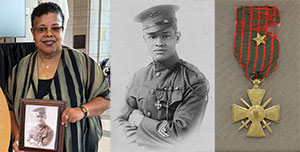
For most of the 369th’s Black members, it would take years, even decades, to receive American military honors. McVey received the Purple Heart in 1932. Johnson received the same in 1996, as well as the Medal of Honor in 2015.
In late 2021, the 369th Infantry Regiment was awarded the Congressional Gold Medal—well after its members had died.
“They need to be honored,” McVey said, “because they fought for a country that didn’t fight for them.”
More than a century after the Harlem Hellfighters marched up Fifth Avenue to thunderous cheers, their story still resonates—proof that courage often arrives long before recognition.
As the echoes of that parade fade, the nation can finally hear what was once drowned out: the call to honor all who fought for freedom.
Related News & Events
Veterans benefits increase 2.8% to keep pace with inflation
Community Impact Day: What happens next is up to you

Be a voice for veterans
Critical policy goals lay the roadmap for advocacy