 For over a century, DAV’s critical policy goals have served as a strategic road map, guiding our members to create positive change and achieve long-term success for veterans and their families.
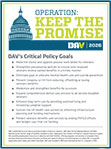
In 2026, DAV is focusing its advocacy across nine key issues.
First and foremost, DAV wants to make the process for filing disability claims and appeals work better for veterans. The Clear Communication for Veterans Claims Act (S. 1311/H.R. 1039) would require the Department of Veterans Affairs to recommend improvements to the letters and notices it sends veterans, and the Veterans Claims Quality Improvement Act (H.R. 3983) would reduce preventable errors by requiring an enhanced quality assurance framework at the Board of Veterans’ Appeals.
The enactment of the Honoring our PACT Act of 2022 provided expanded health care and benefits for toxic-exposed veterans—the largest such expansion in a generation. The law improved access to care for millions of veterans, created presumptives for burn pits and other toxic exposures, and established an internal VA process for creating future presumptive conditions. However, the PACT Act lacks adequate accountability measures to ensure timely decisions, leaving many veterans still waiting for recognition of service-connected toxic injuries, including those who served at Karshi-Khanabad Air Base (K2) in Uzbekistan, Fort McClellan in Alabama, and other per- and polyfluoroalkyl substances (PFAS)-contaminated locations. DAV is urging Congress to establish a new framework for toxic-exposure presumptives that includes separate steps for the acknowledgment of exposure events, concession of exposure and presumption of service connection. Additionally, it should enact legislation that directs the VA to expand research, create independent scientific review and establish a veterans advisory commission to ensure prompt, transparent and equitable decisions.
Other policy goals to end the wait for toxic-exposed veterans include passing the FORGOTTEN Veterans Act (S. 2220), which would establish a presumption that certain veterans were exposed to radiation and other toxins at the Nevada Test and Training Range, and the Veterans Exposed to Toxic PFAS Act (H.R. 3639), which would provide health care and establish presumptive service connection for veterans and dependents exposed to PFAS at military installations.
Reducing veteran suicide remains a key focus for DAV, the VA and Congress. The BRAVE Act (S. 609/H.R. 6024), which includes recommendations from DAV’s report Women Veterans: The Journey to Mental Wellness, would strengthen the VA’s mental health and suicide prevention efforts by expanding the mental health workforce; modernizing Vet Centers; improving outreach, especially to women veterans; and enhancing coordination of prevention programs.
Although DAV benefits advocates are skilled at navigating the complex VA benefits system, a crucial legislative change is required: The law must be amended to allow the concurrent receipt of earned military retiree pay and veterans benefits. Currently, a combat-disabled veteran is often forced to repay Department of Defense retirement pay before they can even qualify for VA disability payments. The Major Richard Star Act (S. 1032/H.R. 2102) seeks to eliminate this inequitable offset. Furthermore, the Retired Pay Restoration Act (H.R. 303) would allow receipt of both military retired pay based on longevity and veterans’ disability compensation rated 40% and below.
Other critical policy goals include modernizing survivor benefits, such as Dependency and Indemnity Compensation (DIC) for veterans’ survivors. Two instrumental bills—the Love Lives On Act (S. 410/H.R. 1004) and the Caring for Survivors Act (S. 611/H.R. 680)—will do just that. They will eliminate the penalty for a surviving spouse who remarries before age 55 and increase the DIC compensation rate to 55% of a 100%-disabled veteran’s compensation, up from 41%.
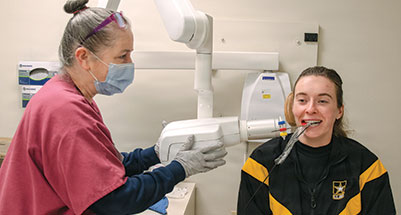
DAV will also continue to fight to expand comprehensive dental care services to all service-disabled veterans, enhance long-term care by providing assisted living care and increasing caregiver support, sustain the VA health care system, and protect veterans benefits and services from budget caps and offsets.
“When Congress seeks to strengthen the lives of those who served, they rely on DAV’s proven leadership and expertise,” said DAV National Legislative Director Jon Retzer. “From pioneering health care solutions to relentlessly closing the gaps in toxic-exposure legislation, DAV’s unwavering advocacy is the shield that ensures our nation keeps our promise to every veteran.”
Be the voice that veterans rely on. Your dedicated advocacy is required to push these critical policy goals across the finish line. Find out exactly when and how to contact your lawmakers by joining DAV CAN (Commander’s Action Network) at davcan.org—and help ensure we keep our promise to America’s veterans.