
THE CLAIMS PROCESS To receive certain health care benefits, veterans have to prove that an incident or exposure happened during service and that it caused or aggravated an injury or illness. This establishes service-connection and results in a disability rating, which determines a veteran’s eligibility for health care and benefits.
Ending the Wait
Ending the Wait for
TOXIC-EXPOSED VETERANS

A PARADIGM SHIFT
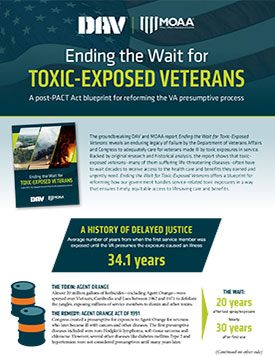
DAV and MOAA’s groundbreaking report, Ending the Wait for Toxic-Exposed Veterans, reveals that on average, toxic-exposed veterans—many of them suffering life-threatening diseases—have to wait 34.1 years to receive access to the full range of health care and benefits they earned and urgently need. Tragically, some die before that ever happens.
DAV and MOAA offer a blueprint for dramatically reforming how our government handles service-related toxic exposures in a way that ensures timely, equitable access to lifesaving care and benefits. The mission is simple: Ending the wait and keeping our sacred promise to America’s veterans.
Download Fact Sheet
Download Infographics

Download Full Report
UNDERSTANDING TOXIC EXPOSURE
THE CLAIMS PROCESS
THE TOXIC CHALLENGE
PRESUMPTIVES
KEY FINDINGS
RECOMMENDATIONS
DAV and MOAA provide more than a dozen policy and research recommendations for the VA and Congress, intended to help end the wait for millions of current and future toxic-exposed veterans. They include:
MEET THE VETERANS
Click on image to read veteran’s story.
Mark Jackson
Army veteran
“The very first thing I write about is my throat and my eyes stinging from … this rotten smell,” the Army veteran said. “The next day, my journal entry said, ‘This place is toxic.’” Jackson soon found himself logging a long list of symptoms: coughs, headaches, rashes, shortness of breath, fatigue.
Mark Jackson
Army veteran
Al Lewis
Marine veteran
“I remember watching our planes spray a substance around the base to clear out the jungle,” Lewis explained. “We would end up walking through the substance while on duty at various points of the deployment and thought nothing of it at the time. It wasn’t until years later that we learned that it was Agent Orange and the impact it had on our health.”
Al Lewis
Marine veteran
Andrea LaForce
Air Force veteran
Six months after leaving Karshi-Khanabad Air Base, LaForce suffered severe abdominal pain caused by a large ovarian cyst that burst. Nearly 20 years later, she continues to develop cysts and experience chronic pain. Her condition is manageable but takes constant care and monitoring. LaForce is also keenly aware that it could one day develop into ovarian cancer.
Andrea LaForce
Air Force veteran
Gary Sauer
Army veteran
Six years ago, retired Army Lt. Col. Gary Sauer was diagnosed with non-Hodgkin’s lymphoma, a type of blood cancer. He had no family history of cancer of any kind, and testing confirmed he wasn’t genetically predisposed. But over his 22-year military career, Sauer—who was also diagnosed with a rare kidney disease—served at numerous installations known to have the presence of perfluoroalkyl and polyfluoroalkyl substances (PFAS).
Gary Sauer
Army veteran
David Crete
Air Force veteran
“About 20 years after leaving TTR, I developed lipomas and even had one about the size of a grapefruit removed from my back because it was causing so much pressure on my spine,” Crete said. “I also have several other lipomas that may need surgical removal in the future, but fortunately they have all tested benign so far.”
David Crete
Air Force veteran
MULTI-MEDIA RESOURCES
Hear from veterans affected by toxic exposure.
WAYS YOU CAN HELP
No matter who you are, you can help DAV and MOAA keep our nation’s sacred promise to care for veterans forever changed by service.
Advocate with DAV
DAV fights for legislation that protects the rights and benefits of all veterans, including those made ill by toxic exposures. Stay up to date and help advocate for key legislation that will affect our nation’s heroes and their care by signing up for DAV CAN (Commander’s Action Network).
Take action with MOAA
MOAA’s greatest mission is to improve the lives of those who serve and their families, which is achieved largely through the tireless advocacy efforts taking place in our nation’s capital. For more than 90 years, MOAA has supported legislation that benefits the uniformed services community and has remained equally vigilant when fighting to stop legislation that threatens our livelihood. Sign up for MOAA’s Legislative Action Center.
Share your story
Your story can affect the lives of others in profound ways. Use your service-related experiences to help influence our elected officials to support and advocate for our nation’s veterans, their families and their survivors.
If you have questions about or need assistance with filing for VA disability compensation related to toxic exposure, please contact your nearest DAV service office.