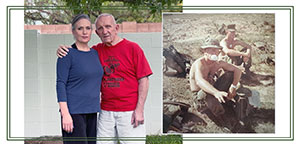
Every morning, Marty Patterson takes the same route with her dog through her Phoenix neighborhood, past familiar houses and quiet streets. One day, she noticed an older man sitting in a chair outside. Then she noticed that his license plate displayed a Purple Heart.
That was enough for her to stop and talk to Marine veteran Stephen Jameson. Marty listened and went back to her morning.
A few days later, Marty’s husband made contact, and they spoke at length about Jameson’s time in Vietnam. Two hours flew by.
“The stories just flowed out,” said Kirk Patterson, a benefits advocate at DAV’s Phoenix office. “He was talking about incoming fire, bullets on both sides of his feet, watching his buddy get hit.”
Patterson was struck by how nonchalant Jameson was about his stories.
“He said it like it was nothing new,” he added. “No emotion, just here’s what happened.”
Jameson joined the Marines in June 1967—six days after earning an associate degree. The Marines wanted to screen him for Officer Candidate School. He turned it down. Instead, he was assigned to intelligence, where he served as an S-2 scout with 2nd Battalion, 5th Marine Regiment, using his Vietnamese language skills.
For 13 months, he was in the jungles of Vietnam, rotating out for a day or two before heading back.
“It was combat every day,” Jameson said.
He was present during the Tet Offensive in Hue City, running across a bombed-out bridge, half-blinded by his sweaty helmet sliding over his eyes. With a rifle in each hand, he navigated the holes blown beneath his feet. Jameson also stepped on two land mines during his tour. Neither one went off. He figured “someone up there was looking out” for him.
The day he earned his Purple Heart, his unit was moving up a hill when his friend stepped on a mine and died in the explosion. Another Marine who was sitting on a nearby rock was struck by shrapnel from his feet to his eyes. Jameson caught shrapnel in his legs. He was, as he put it, fortunate.
When Patterson pulled up Jameson’s records, he saw service connections for illnesses related to Agent Orange exposure. Then, he looked at Jameson’s DD-214. The Purple Heart was there. But Jameson had no rating for a combat wound.
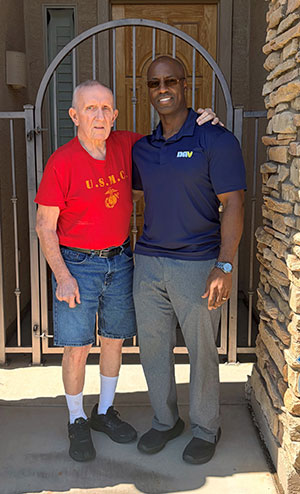
“That caught my attention,” Patterson said. “We had to do something about that.”
Patterson filed a new claim. The PACT Act had changed the landscape for Vietnam veterans, and the Department of Veterans Affairs subsequently conceded that Jameson had been exposed to Agent Orange. New claims were approved for multiple conditions associated with his combat wounds and his toxic exposure while in Vietnam.
By May 2026, the VA’s final decisions came through with life-changing news that left Jameson’s daughter and caregiver stunned.
“I actually started to cry,” said Erin Jameson, who was moving her daughter out of her college dorm when Patterson’s call came through.
The need for a higher rating had become urgent after Jameson collapsed during a walk in September 2025. He had walked for an hour every morning and completed 165 pushups and 105 situps each day. A narrowing of blood vessels had cut blood flow to his brain. He fell, gushing blood from his scalp. His wife, Marylois Jameson, found him sitting in the living room, with blood on his face and no memory of what had happened.
The VA kept him for two days. Doctors told Erin she should consider placing Jameson in a facility. She brought him home instead.
Now legally blind and managing cognitive decline, Jameson can no longer drive, cook, use a microwave or dial a phone. Erin handles all of that, alongside her own job, children and household. The new rating means financial relief and the security of knowing that her dad’s VA benefits will be there if he ever needs more care than she can provide.
“It released a huge load,” Erin said.
For Jameson, the benefits are inseparable from something more difficult to name—a sense that what he carried for more than five decades had finally been seen.
For Patterson, the work is its own reward.
“You’re able to get to the crux of what this veteran is actually going through,” Patterson said, “and then get the VA to see that this veteran deserves the care he’s earned.”
Sometimes, a morning walk and a license plate are all it takes.
Related News & Events
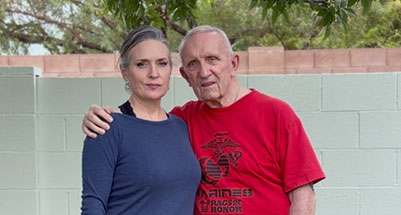
A morning walk, a Purple Heart, a debt paid