

Pursuing the highest degree of caregiving for his veteran mother
A devoted son recalls the challenges and joys of caring for his veteran mother through her incurable illness.

Karen Dennison loved to learn, whether earning certificates for crafting classes or adult-education programs. An Air Force veteran, she obtained her bachelor’s degree in 2007 through online courses while receiving home-hospice care for an incurable autoimmune disease. In April, Karen died at age 61, leaving her youngest son, Corey Dennison, a legacy of life lessons shaped by a mother’s love.
Since his mother’s death, Corey, 32, who had been her caregiver since 2018, has been taking time to heal. DAV Caregivers Support has been part of that process. With the support of friends and mentors, he also worked this summer to determine when he will re-enroll to complete his doctorate in medical ethics and return to work.
“I think there is a big expectation of ‘What are you doing for work?’ And in my mind, I feel like I’ve done the most important job that I’ll ever do, so work, in that sense, is not super top of mind in terms of validation,” he said.
Corey, who will return to school in the spring, began helping his grandfather, Julius, care for Karen when he was 13. She lived for more than 20 years with systemic scleroderma, a rare, chronic autoimmune disorder that affects connective tissue and internal organs. She endured numerous hospitalizations; used a feeding tube at times; and, in the past few years, needed supplemental oxygen and mobility aids. During her adult life, Karen also experienced significant mental health issues, her son said.
“She was a woman, and a woman of color during a certain time period, and I think for me, I didn’t realize how that intersected with the mental health piece,” Corey said at his mother’s service. “There’s a way in which women’s experiences in the military kind of do get either lumped together or glossed over.”
Working together as a team
Karen enlisted as a high school senior and served for 15 years as a financial counselor and Air Force aid officer. She was paired as a pen pal with another Air Force member, and they met while stationed in the Philippines, Corey said, eventually marrying and having three sons. His parents’ marriage ended when Corey was in high school, and he went on to live with his mother. During his adolescence, Karen was in hospice care multiple times.
“In my mind as a teenager, I think I was deeply worried about my mom dying throughout the years and what that would look like for me,” Corey said. “I definitely did some growing up in those years, having to do some of the caregiving or grocery shopping.”
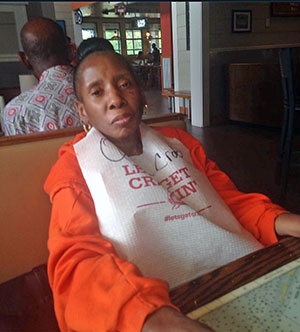
Despite her illness, Karen worked to ensure that Corey had as normal a childhood as possible, even if it looked different and required more planning. She was an early adopter of online shopping to buy him Christmas gifts, Valentine’s Day chocolates and Easter baskets, into his 20s, he said. Karen planned a party for his undergraduate degree, even folding napkins into swans, and she also enjoyed volunteering with the National Scleroderma Foundation, wrote Valentine’s Day cards to veterans and called to check on them during the holidays to make sure they had adequate food, Corey said.
As her illness progressed, Karen’s mobility became more challenging. Together, she and Corey would order mobility aids online, and while she read the instructions, he would put the devices together, doing the physical things she no longer could.
“We were a team, me and her,” he said.
Perseverance and determination
During his first semester of college in Florida, Corey moved back to the Philadelphia area following a “pretty dangerous” mental health episode his mother experienced. He took classes at a nearby school, earning his bachelor’s degree over seven years while caregiving. Medical anthropology, gender studies and medical humanities courses helped him better understand his mother’s illnesses and his role in her life, he said. They also helped him identify that the large fluctuations in his grades were a result of caregiver stress and burnout.
At one point in his schooling—some of which was online during the COVID-19 pandemic—Corey worked overnights at UPS, took classes during the day and another at night, and cared for his mother. Looking back, he’s not certain how he accomplished everything.
“I couldn’t justify giving up to myself just because there were so many times where she was in a medical situation where she could have easily and probably rightfully chose to forgo treatment and end things there, and she always wouldn’t, largely because of me or oftentimes, too, because of her own willpower to be like ‘I still want to do things and achieve things,’ and she would do that.”
When he left his doctoral program to fully focus on his mother’s care, Corey was close to defending his dissertation. In 2023 and 2024, he was able to present some of his research at conferences overseas. Those trips occurred when his mother was hospitalized. While difficult to be away, her hospitalizations became the only time he could get some respite, he said, which was necessary for his well-being.
A circle of supporters
During his mother’s first time in hospice about 20 years ago, her friend, Patricia Cofer, a hospice nurse, shared information about things they could advocate for and how to advocate for them that would improve their quality of life, Corey said. In the last year, Corey said his best friend and cousin also helped him. Throughout Karen’s life, her father, older sister, an aunt and grandparents were her rock, Corey said, as were friends from the military and her faith community.

While he experienced some frustration with providers who he said didn’t read his mother’s medical records before meeting with her for care, some of her specialists, including her pulmonologist and eventually a concierge primary care provider, also helped to make things easier for them. Their social worker at the Philadelphia VA was also instrumental in helping Corey and his mother navigate that system, and he said they particularly appreciated her ability to reach out within the Department of Veterans Affairs on their behalf when they needed assistance.
Corey was part of a VA caregiver program when he learned about DAV Caregivers Support during an intense period of caregiving in 2025. He said he jumped at the chance to enroll and complete its online risk screening.
“They were able to really help support me in developing different strategies of where I was in caregiving at the moment,” Corey said. “Loss of identity was very high for me.”
He was managing his mother’s appointments and medications well but said he felt that their mother–son relationship was deteriorating. The assessment and support helped them rebalance their relationship.
“The risk screening assessment is one of the most important tools we provide for caregivers,” said DAV National Caregiver Support Program Director Ron Minter. “It helps to inform us of how we can provide the best support for a caregiver and how we can develop their personalized care plan to best support their loved one.”
DAV Caregivers Support also assigned Corey a trained caregiver specialist who helped him advocate for in-home nursing and home health support. Having a specialist who understood the unique aspects of caring for a veteran helped too, he said.
Making the most of their time
Choosing to become a caregiver deepened his understanding of Karen as his mother, Corey said, and of her as a person in the world. He is grateful to have had the opportunity.
“I gained a lot and I just think that’s the biggest takeaway. Yes, I poured a lot of myself, and I put everything that I had and then some,” he said. “I still think I got a lot back too, which is, I think, often overlooked, and maybe why I think people avoid it. It’s because they feel it just takes too much from them.”
Through the toughest hospitalizations, Corey said he and his mother found ways to laugh, talk and distract themselves. Karen was a sweet-natured person who had deep faith, a determined will to live, and a joy and love of life. Even through her last hospitalization, Corey and Karen’s family remained optimistic, and her death came as somewhat of a shock. Because of their closeness and the length of time Corey cared for her, his grief looks different than it may for others, he said.
“It’s a big loss in the sense of what she meant to different people in her life and for me. I can really, thankfully say I don’t have any regrets,” Corey said. “I made sure I made the last four to five years count, made them special, even through in and out of hospitalizations and things, so I have a big piece of freedom even in the sadness and the loss.”
Learn more at davcaregivers.org.

Related Content
‘The most fun ever’
They came to learn an art. They found confidence, connection and a community.
Meeting veterans where they are
Inside DAV’s gaming program, where volunteers meet veterans in a 100,000-member Discord server.
Finally seen
After years of health problems and frustration with his VA claim, Navy veteran Daniel Kerr had nearly given up. Then, he found hope.
