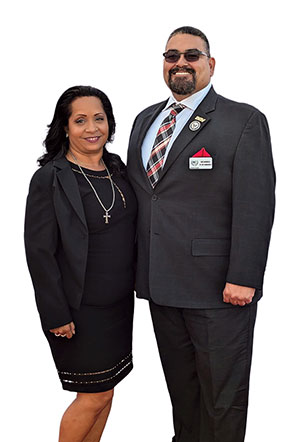
Jose Mendoza doesn’t shy away from his past.
Struggling with direction after the Navy. Substance abuse. Spending time in prison. Getting laid off from his job. Experiencing homelessness.
Then came finding community, healing, purpose and a mission to help other veterans get out of the “foxholes” they find themselves in.
“I want to jump in the hole with you, and I want to help you get out,” Mendoza said. “Somebody helped me.”
Mendoza was medically separated from the Navy in 1999 after a car accident caused a traumatic brain injury (TBI) and vision loss.
The transition was difficult. He wasn’t fully aware of benefits or resources available to him and was trying to cope with post-traumatic stress on his own.
“I was self-medicating,” he said. “I didn’t care if I lived or died.”
He later wound up in prison for drug and weapons charges.
After finishing his sentence in 2006, he got a job and met his now-wife Joanne. The couple started building a life together in Rancho Cucamonga, California, outside Los Angeles.
Then the Great Recession hit in 2007, and they lost everything—their apartment, possessions and temporarily lost custody of Joanne’s three children. The couple lived in hotels, out of their car and in a friend’s apartment.
In early 2008, they’d saved enough money for a one-bedroom apartment and were allowed to get the kids back.
“It was in the middle of the worst neighborhood, but we had to start from somewhere,” Jose said.
Because of his eye injury, TBI and PTSD, Jose avoided people. He was self-conscious about how he looked and wore dark sunglasses to hide the wound. Living in that confined space made processing it all more difficult.
Unemployed and full of self-loathing, he had a hard time controlling his temper. He’d have nightmares—screaming and thrashing in his sleep.
“It compounds,” Jose said, “and there’s nowhere for you to go when you’re frustrated.”
Joanne finally convinced him to seek help at the Department of Veterans Affairs. She’d encouraged him in the past, but he realized he was getting worse.
“It got so bad that I went to the VA hospital myself, and I sat there and I said, ‘I need help,’” Jose said. “I just broke down.”
He started seeing a doctor and attending group classes for PTSD. He was withdrawn at first, but as he listened to other veterans’ stories, he found he could relate to them and started opening up.
But back at home, he and Joanne would frequently argue. That escalated to a moment where Jose hit Joanne. He said he initially tried to run from the situation but realized he had to make amends for what he did.
“I turned myself in,” Jose said. “I went to domestic violence court. I knew I had messed up my partner, and I didn’t know how to fix it. I messed up the person I was closest to that was trying to help.”
They separated for two months after the incident as they worked to figure out their future. They ultimately wanted to reconcile.
“I knew there was something in our relationship,” Joanne said. “We just needed that ‘one help’ to get us back on our feet.”
They found it through the VA and a community counseling provider. Joanne and Jose both sought individual treatment, attended marriage counseling together and ensured their children also received counseling.
“When I destroyed the family, I realized that I had to bring my family back together, and so we did a lot of this stuff together,” Jose said.
Jose also continued to receive therapy for his PTSD and TBI and attended the VA Substance Treatment and Recovery (STAR) program.
“I had a lot of help at the VA hospital,” he said.
Over time, the Mendozas’ situation improved. They moved into a townhouse. They volunteered together at the VA hospital, accumulating thousands of hours. Their marriage grew stronger.
“She stood by me through the hardest times of life, and that’s why I value our relationship so much,” Jose said. “We stuck together through the worst times there was, and I think that’s what makes us so strong.”
“I knew if we worked together, we could do whatever we wanted,” Joanne said.
A highlight of that partnership and tenacity came after they moved to Victorville in California’s High Desert in 2013. They had an opportunity to move into a bigger home in a nicer neighborhood, but it was a transition Jose was unsure about at first. He had come to rely on the VA medical center and the Vet Center in San Bernardino.
“I was moving an hour away, and there were no resources up there,” he said. “I was scared that if I didn’t have resources, I was gonna fail.”
The Mendozas’ solution was to create their own community and resources.
“The more I helped other people, the more it helped me,” Jose said.
Joanne was alongside him every step of the way. This included organizing events such as Victorville’s first Veteran Appreciation Cruise Day in 2016.
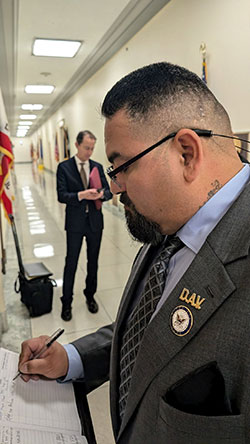
Around this time, the Mendozas met Joseph Moseley at an event where they were all volunteering. Moseley was then the commander of DAV Chapter 12 in San Bernardino and immediately connected with Jose.
“He was motivated to give back,” Moseley said. “What I saw was a guy who cared and was willing to put in some time and maybe just needed a chance. What I saw was a guy who wanted to repair his life, which is the DAV story, right?”
Moseley invited Jose to join DAV, mentored him and urged him to take on chapter leadership roles.
Through all this, Jose still struggled with how he felt he was perceived by others.
Then he learned about and attended the National Disabled Veterans Winter Sports Clinic, an event that DAV presents with the VA every year in Colorado. He remembers being inspired by watching amputees and other severely disabled veterans ski down the mountain, enjoying themselves.
“It just changed my life,” Jose said. “It showed me there’s more after your disability.”
Today, Jose and Joanne are familiar faces around Chapter 12 and its Auxiliary unit. He’s currently the chapter commander and she’s the Auxiliary unit adjutant. Jose also currently serves as the senior vice commander for the Department of California. They’re both focused on helping other veterans find purpose, community and support through DAV.
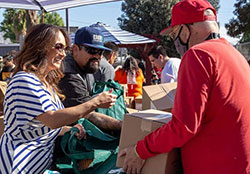
The chapter’s building is open five days a week, offering a wide variety of opportunities to be involved, including benefits seminars, scuba diving outings, amateur radio classes, drone piloting classes, Bible studies, a gardening club and a food pantry.
“We’re trying to meet the veteran where they’re at,” Jose said. “We’ll do anything to help a veteran.”
Moseley said Jose’s journey has been inspiring to many veterans.
“You want to find the one who actually struggled and found success,” Moseley said. “That’s what he’s doing. He’s finding success, and he’s sharing it.”
Mentees include Jarod Behee, an Army veteran and fellow winter sports clinic participant who found a new mission through Chapter 12.
“I was struck in the head by a sniper when I was in Iraq. Meeting Jose and being mentored by he and Joe has made a huge difference for me and my wife, Julie,” said Behee. “We’re an incredibly active chapter, and everyone looks out for each other. When you have a severe traumatic brain injury, it makes it more difficult to handle some of the admin stuff, but they’re the kind of people who make sure no one is ever left behind and they’ve helped me through it.
“[Jose’s] gone through a lot of pain, but it’s made him a better leader, and he has changed a lot of people’s lives in ways that give them hope. Mine included.”
Jose’s work extends beyond DAV. He mentors veterans through his county’s Veterans Treatment Court. He sits on a veterans advisory committee for U.S. Rep. Pete Aguilar and works with local leaders on veterans’ issues.
His recognitions include being named a 2024 Veteran of the Year honoree by California State Sen. Eloise Gomez Reyes and a 2025 JPMorgan Chase Community Icon honoree.
After more than a decade of involvement, Jose and Joanne aren’t slowing down, but they are shifting focus to find and mentor new DAV leaders.
“You don’t have to be a superstar sniper; you don’t have to be some recon warrior,” Jose said. “You can be a cook in the Navy, like I was, and still make a difference in our community.”
If you’re experiencing intimate partner violence, find support by calling the National Domestic Violence Hotline at 800-799-7233 or TTY 800-787-3224. If you’re a veteran in crisis, call the Veterans Crisis Line at 988, then press 1, or text 838255.