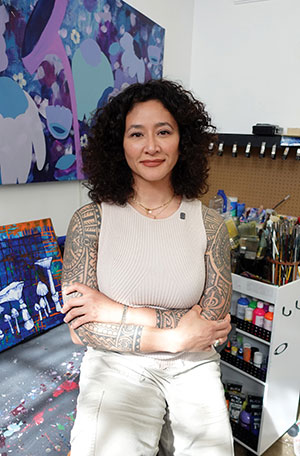
 Standing at her canvas in her studio in Virginia, Sam Juan brushed the surface and felt her shoulders drop. The Army veteran, artist and advocate spent years seeking healing from wounds that lingered long after her service. Painting became her way to breathe again.
“When I get into that flow state, it’s a deep exhale,” she said. “I’m extremely grateful for the practice.”
Juan’s journey to this moment was anything but easy. As a former Army Cultural Support Team (CST) member serving with America’s most elite special operations forces, she carried the weight of childhood trauma, combat and a tough transition from soldier to veteran. Today, she helps fellow veterans confront their struggles, earning recognition as DAV’s 2026 Disabled American Veteran of the Year.
Like her service in Afghanistan, Juan’s path to the Army wasn’t conventional. An immigrant who grew up in Bahrain, she moved to California at 14 for high school. She enlisted in the Army in 2003 as a food service specialist. While stationed in Germany, she took the oath to become a United States citizen.
“It was a surreal experience,” she said. “I never thought I would do that on my own. I was one of the first in my immediate family to become a citizen. There’s a lot of pride there.”
After, Juan switched specialties and became a signals intelligence analyst. She was stationed at National Security Agency Hawai’i where, in 2011, she saw a poster in the women’s bathroom that read, “Become a part of history.”
“It was so elusive and vague, I didn’t know what I was signing up for,” she said. “But my leadership thought I’d be perfect.”
She applied and was accepted to the Cultural Support Team.
At a time when women were barred from combat roles, the Army created small groups of highly trained female soldiers. These women accompanied special operations teams in combat zones to interact with Afghan women and children.
“It was the highlight of my career,” she said. “Being able to operate with SEAL Team Six and exemplify that type of service member—I’m very proud of my experience.”
One motivation pulling her toward CSTs was the perception that women were less capable than male soldiers.
“We were always ridiculed, even during selection,” she said. “That was more of a driver for me not to mess up, so that women behind or after us could continue.”
“She could shoot, move and communicate in a way that I hadn’t seen before,” said Alex Robinson, a former Army officer who served with her on a CST. “She was someone I looked up to. I was an officer, but she was a badass.”
Firefights and taking doors—the sorts of things most people associate with SEAL operations—are not what stands out in Juan’s memory from Afghanistan. For her, it’s conversations with families, mothers and their kids. She helped a new 15-year-old mother breastfeed for the first time. Another time, she sat with a woman who had just lost her family.
Hardly the elements of war novels and streaming series.
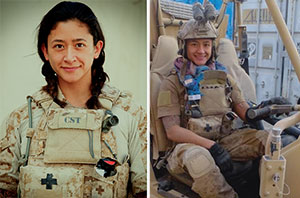
Even still, war had taken its toll, and six months after leaving Afghanistan, she felt lost without the Army.
“I’m newly married and immersing myself in schoolwork as I would in that unit,” she said of that time, during which she was in art school. “My nervous system couldn’t tell the difference; I kept pushing hard.”
She was not only pushing hard but also pushing away a lifetime of formative trauma compounded by her experiences in Afghanistan. The violence and chaos of battle, coupled with the intimate conversations and interactions with innocent women and children in villages where the teams operated, left Juan with memories that she wanted to escape.
“These memories don’t go away,” she said. “Some of the things we did out there … I’m not proud of.”
Despite earning Pat Tillman and Navy SEAL Foundation scholarships, Juan relied on alcohol, Adderall, other pills and cocaine. She completed schoolwork but often went days without sleep, or she would crash and sleep for 18 hours. Struggles grew as she began using opioids.
“To mitigate the pain, you do more,” Juan said. She began to slip. The drugs took hold. She missed work and stood people up.
“On the outside, it looked like I was winning,” she said. “Inside, I didn’t know who I was.”
In early 2020, she realized she needed help. She reached out on social media, becoming vulnerable in the process. Support and compassion poured in, including a recommendation of psychedelics.
“I was at such a low point,” she said. “I could tell the therapist what she wanted to hear, but I wasn’t feeling any healing.
“When I started doing psychedelic therapy, it was immediate.”
She attended a Native American church in California, where she learned how to use plant medicine respectfully and ceremonially.
“I fell away from the church a long time ago, but being in that environment was a way for me to connect with God,” she said.
The next year, at a retreat in Texas, she received psilocybin and 5-MeO-DMT. Surrounded by special operations veterans, she felt at home.
“What stood out to me was just how strong, but how guarded, she was,” said Dr. Martín Polanco, founder and medical director of the retreat’s organizer, The Mission Within, a clinical program specializing in psychedelic therapy.
Shame and guilt surrounded Juan, fueled by a history of sexual trauma. Again, she turned to Polanco for treatment in 2023—this time for ibogaine.
“When I finally did ibogaine and was able to pause from that lifestyle long enough for me to change my habits … change my routine. That’s what really made the difference,” she said.
Juan has not used opioids since. Sober and focused, her life and her art have flourished.
Initially, Juan shared her story to heal herself, but she soon realized its power to help others.
“(Sharing) normalizes the suffering and the issues veterans are dealing with, and it allows people to seek help,” Polanco added.
DAV selected Juan not only for her distinguished and groundbreaking military service, which helped pave the way for women serving alongside special operations forces, but also for the example she continues to set for veterans nationwide.
She was the first veteran to speak with DAV on camera about her ibogaine journey. She also brought the physicality that served her well in service to the flag football game, the DAV Bowl, in February.
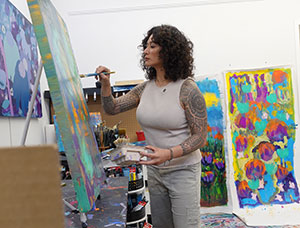 Through her advocacy, artwork and willingness to speak openly about mental health, addiction and recovery, she has helped other veterans recognize that seeking help is a sign of strength.
“Sam has taken experiences many people would prefer to keep private and turned them into opportunities to help others,” said DAV National Adjutant Barry Jesinoski. “Overcoming adversity is commendable, but Sam is far rarer—she has transformed her pain into action that has saved her own life and the lives of her fellow veterans.
“DAV is proud to have her in our ranks.”
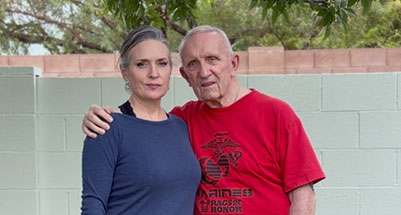
Juan has also helped strangers and friends, including Robinson, the former Army officer who served with her and struggled after leaving the military. Close to suicide, Robinson received an unprompted call from Juan.
“She said she could get me to Mexico (for psychedelic therapy) within two months,” said Robinson, who now works for Heroic Hearts Project, a nonprofit that brings veterans abroad for psychedelic treatment.
Juan has spoken to members of Congress and other policymakers about her experiences. As a social media influencer, she regularly shares her trials and triumphs.
“If I can share my life’s story and be of service that way, it just feels like an authentic way for me to be,” she said. “I spent decades not saying anything.
“Now, I finally have a voice.”
Related News & Events
Recreation therapy helps veterans rebuild life after injury
Thousands helped, more welcome
The modern covenant
A morning walk, a Purple Heart, a debt paid