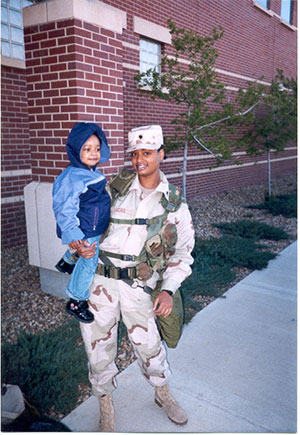
Even before she was old enough to understand the role, Sanaa Lucas has been a caregiver. She was 2 when her mother, Latoya Lucas, was severely injured in a rocket-propelled grenade attack in Iraq while serving with the Army’s 52nd Engineering Battalion in support of the 101st Airborne Division.
Latoya sustained significant burns on her left side and lost the use of her left hand and left foot. She also experienced a traumatic brain injury, developed post-traumatic stress disorder and anxiety, and has a colostomy bag. Latoya spent five months at what is now Walter Reed National Military Medical Center with her daughter and her husband, Mike, a Marine veteran, by her side. As a toddler, Sanaa helped her mother by doing tasks such as bringing her a napkin from a bedside table or holding a cup of ice water to Latoya’s mouth so she could take a drink.
“It meant the world to me,” Latoya said of waking up from surgery at Walter Reed and having her husband and daughter with her. Mike and Sanaa lived in a hotel on the hospital grounds during Latoya’s hospitalization. “They would come over every day,” she said. “She was just always being that strong pick-me-up helper.”
Attending her mother’s medical appointments became second nature to Sanaa.
“From an early age, all she knew was doctor appointments and hospital visits and things like that, and that’s not something normal for kids her age to really experience on a day-to-day basis, and especially for how long she had to do that,” Latoya said.
Sanaa vividly remembers attending Latoya’s medical visits but has vague memories of being on the hospital ward and seeing other wounded service members, some who were disfigured, who had lost their limbs and whose head wounds were wrapped in bandages. Though difficult for a child to comprehend, the experience instilled empathy and compassion in the little girl, particularly when she later saw wounded veterans in public.
“I had an understanding,” Sanaa said.
As a high schooler, Sanaa began to encourage her mother, who lives with daily pain, to explore nonpharmaceutical approaches to her wellness, including holistic acupuncture.
She continues to advocate for Latoya’s health and recently introduced her to the meditative healing practice of breathwork and sound baths, where participants lie on the floor while the harmonious tones of quartz singing bowls wash over the body, instilling a feeling of calm. The pair, who share an obviously close bond, recently traveled to Albany, New York, for a session with a Reiki master. The experience was transformative for Latoya, who expressed it also appealed to her because of its physical accessibility for anyone.

“It was fabulous and fantastic,” Latoya said. “I felt so good afterward, and that’s something I really want to incorporate into my healing journey and my recovery, which is always ongoing.”
Sanaa, 25, resides near her parents; works in government relations in the Washington, D.C., area; and plays viola with the Washington Metropolitan Philharmonic. Her love of music began with violin lessons when she was 9 and has become a way to ground herself, particularly in highly tense situations. A deeply introspective person, Sanaa has had her life molded by being a caregiver for more than two decades.
“I think it shaped me tremendously,” Sanaa said. “I think just always being mindful of this thing that is bigger than me, like my mom’s sacrifice and how much she’s contributed to our family, just kind of keeping that at the forefront.”
Throughout the United States, there are an estimated 2.3 million child caregivers, according to a 2022 White House study. They provide critical support to their loved ones while balancing the rigors of growing up.
“Child and young adult caregivers play an enormous role in the health and welfare of our nation’s veterans,” said DAV National Caregiver Support Program Director Ron Minter. “The responsibilities they carry and the care they provide are remarkable and reflect a maturity beyond their years.”
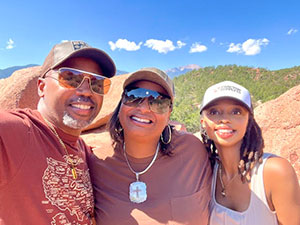
Though Sanaa’s home life differed from her classmates, her school life and friendships were “pretty normal.” Music helped, and her constancy in assisting her father in caring for Latoya permeated through her friendships and relationships. Her caregiving role has also motivated Sanaa to give back to other military children. A DAV Auxiliary member, she’s also involved with a military scholarship program and spoke on a panel in the spring to provide career and professional advice. Sanaa and Latoya share gratitude and mutual appreciation for each other. Sanaa is also grateful that she was able to process and understand her mother’s situation, even from a young age. For others in similar caregiving situations, she encourages being patient, staying positive and sticking together.
“Love is really at the root of it all,” she said.
Learn more at davcaregivers.org.
Related News & Events
A morning walk, a Purple Heart, a debt paid