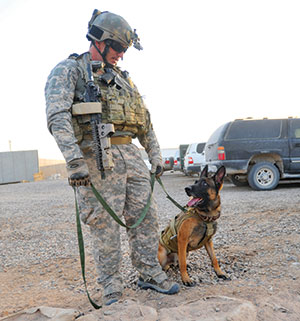
The first time Matthew Bessler handled ketamine was for his military working dog, a Belgian Malinois. Army veterinarians issued the anesthetic controlled substance in the unfortunate event that dogs like Bessler’s—trained to track personnel and detect explosives—became injured.
“If they got shot, had any trauma or anything like that, they’d use ketamine to sedate them,” said Bessler, who served with the 10th Special Forces Group as an engineer sergeant.
Thankfully, he never had to administer the drug.
But little did Bessler know he’d one day use ketamine as an at-home treatment for severe post-traumatic stress disorder (PTSD)—a condition he developed after service in Somalia, Haiti and multiple deployments to Iraq and Afghanistan.
Ketamine was first synthesized in 1962. During the 1970s, service members in Vietnam used it for battlefield surgery; however, much like other drugs, ketamine left the lab and the field and was quickly abused. By the 1990s, much of the conversation about the anesthetic centered around its illicit use, and in 1999, it was listed as a federally controlled substance.
However, a new dawn of research has sparked scientific inquiry into ketamine’s potential healing power for mental health disorders. Studies conducted in the early 2000s showed ketamine could be effective for treatment-resistant depression. Today, medical professionals use it to provide long-awaited relief for those suffering from that condition.
Service had taken a toll on Bessler. He once had a hamstring reattached, extensive injuries to both of his feet, and torn ligaments and tendons in his shoulders. He also suffered a severe traumatic brain injury (TBI) in his pre-frontal cortex, the part of the brain that regulates emotion, cognitive control and decision-making.
Beyond his physical wounds, Bessler has struggled with the mental and emotional scars of war. His TBI mimicked another serious health condition’s symptoms, which included mood swings, irritability and impulsiveness.

“It was almost like a bipolar psychosis,” he said. “There was no way to get control of it because somebody could say one thing, or I could smell something, or I could see something, or something would happen, and it would flip the switch, and it was downhill from there.”
The growing interest over the past 25 years in researching ketamine’s potential therapeutic use has led to hundreds of private clinics offering it nationwide and to companies offering at-home treatments.
“I’ve been through almost all of the drugs [the Department of Veterans Affairs] would try to give you,” Bessler said. “And the only ones they gave me are the ones that mess with my psyche so much they don’t work.”
He receives his ketamine in a kit made available by Mindbloom, a U.S.-based telehealth company specializing in at-home, clinician-guided ketamine therapy.
A 2022 study from scientists at Johns Hopkins University and New York University School of Medicine found that 62% of Mindbloom clients reported significant improvements in depression or anxiety, and more than 25% achieved remission. Other clinical studies indicate ketamine can improve moods and decrease suicidal ideation.
“The huge upshot is, you don’t have to take a daily pill for the rest of your life,” said Michael Petegorsky, chief strategy officer at Mindbloom. “So it is more effective and helps many people get better fast and stay better.”
For Bessler, it began with a pill that he placed under his tongue. After seven minutes, he spat it out and waited for the effects before drifting off into a dreamlike, surreal state. For the treatment to be most effective, Petegorsky said that setting intentions and holding integration sessions between treatments can increase ketamine’s benefits.
“Ketamine helps just on its own, but when you do the work around it, you get more benefits, and they last longer,” Petegorsky said.
“Set and setting” is a key concept in psychedelic therapy, referring to the mindset of the individual and the environment where the experience takes place. Positive mindset and safe surroundings can help make the experience healing rather than distressing.
Bessler felt the drug’s effects fade. When the session ended, he contacted his guide to discuss what he experienced.
“It forces you to go through and evaluate some things,” Bessler said. “In my case, it allowed me to accept and move past things.”

Ketamine induces a dissociative state, often making patients feel detached from their surroundings and even their bodies. Its effects on neuroplasticity—the brain’s ability to make new connections—may help reverse trauma-related patterns.
In those with depression and PTSD, neuroplasticity is often impaired, reinforcing harmful thought loops. After a ketamine session, a brief “window of plasticity” opens, creating an opportunity for therapy and reflection.
For Bessler, it helped reduce anxiety and hypervigilance. He’s now able to eat in restaurants, attend crowded events and spend time in downtown Austin—free from the shadow of past trauma like the Battle of Mogadishu.
While ketamine therapy is legal in all 50 states when prescribed by licensed medical professionals, the landscape of its administration is rapidly evolving. The proliferation of ketamine clinics—estimated to number between 1,200 and 1,500 across the U.S.—has led to a wide variance in treatment protocols. Some clinics offer intravenous infusions, others provide lozenges or nasal sprays, and the frequency and dosage of treatments can differ significantly. This inconsistency raises concerns about patient safety and the efficacy of treatments, especially in facilities lacking rigorous medical oversight.
Moreover, the rise of at-home ketamine treatments has prompted warnings from health authorities. The Food and Drug Administration (FDA) has expressed concerns about the risks associated with unsupervised use, including potential abuse and adverse psychiatric events. Experts caution that without standardized protocols and proper monitoring, some treatment models could inadvertently hinder patient recovery rather than help.
The VA offers ketamine treatments for certain mental health conditions. The FDA-approved nasal spray, Spravato, is available through the VA for veterans with major depressive disorder or treatment-resistant depression. Unlike Mindbloom’s in-home treatments, Spravato is administered only under medical supervision, meaning veterans cannot administer the drug to themselves. Less common are intravenous treatments offered by the VA.

While the FDA has not approved ketamine for PTSD, it is often prescribed off-label, as research has shown promise in treating PTSD. However, more robust data is needed. Researchers at the VA are investigating the safety and efficacy of multiple ketamine infusions with prolonged exposure therapy for veterans with PTSD. Yale University is studying ketamine’s effects on PTSD when paired with trauma-focused psychotherapy. And several Stage 2 trials are hoping to uncover similar facts.
Bessler remains an advocate for ketamine and hopes the treatment will someday be widely available to veterans.
“Ketamine has broadened the road,” said Bessler. “It took me from a rocky trail up the side of a cliff to a broad, flattened road. I can actually see my path and pick where I’m going.”